| TEMPLATE ID | Audiogram Report |
|---|
| Concept | Audiogram Report |
|---|
| Description | Not Specified |
|---|
| Purpose | Not Specified |
|---|
| References | |
|---|
| Other Details (Language Independent) | - MetaDataSet:Sample Set : Template metadata sample set
|
|---|
| Language used | en |
|---|
| Citeable Identifier | 1013.26.477 |
|---|
| Root archetype id | openEHR-EHR-COMPOSITION.report-result.v1 |
|---|
| Audiology Report | Audiology Report: Document to communicate information to others about the result of a test or assessment. |
|---|
| Other Context | |
|---|
| Report ID | Report ID: Identification information about the report. |
|---|
| Status | Status: The status of the entire report. Note: This is not the status of any of the report components. |
|---|
| Reason for Encounter | Reason for Encounter: The administrative and/or clinical reason/s for initiation of a healthcare encounter or other service. |
|---|
| Data | |
|---|
| Reason for Contact | Reason for Contact: Identification of administrative reason for intiation of a healthcare encounter.
For example, a clinical consultation, emergency consultation, pre-employment medical, routine antenatal visit, women's health check, pre-operative assessment, or annual medical check-up. Coding of the 'Reason for Contact' with a terminology is desirable, where possible.
- new referral health centre
- new referral self
- review
- opportunistic
- post surgical
- pre-surgical
- administrative
- other
|
|---|
| Presenting Problem | Presenting Problem: Identification of the clinical purpose for initiation of a healthcare encounter.
Clinical reasons for seeking healthcare can include health issues, symptoms or physical signs. Examples: health issues - desire to quit smoking or to lose weight; symptoms - abdominal pain or shortness of breath; physical signs - an altered conscious state. May also be referred to as Presenting Complaint.
Coding of the Presentic Problem with a terminology is desirable, where possible.
- ear discharge
- pain
- hearing loss
- ongoing otitis media
- family concerns
- language concerns
- school concerns
- other
- hearing loss
- failed screening
|
|---|
| Examination Findings | Examination Findings: A generic heading for contextual renaming within a template. |
|---|
| Ear Examination Findings | Ear Examination Findings: Findings observed during the physical examination of a subject. |
|---|
| Data | |
|---|
| Any event | Any event: Default, unspecified point in time or interval event which may be explicitly defined in a template or at run-time. |
|---|
| Data | |
|---|
| Description | Description: Narrative description of the overall findings observed during a physical examination of a subject.
May be used to record a narrative summary of the complete clinical examination or key aspects of clinical examination findings, which will be supported by structured data. Details of specific structured findings can be included using CLUSTER archetypes in the 'Examination Detail' slot. This data element may be used to capture legacy data that is not available in a structured format. |
|---|
| Examination of External Auditory Canal and Tympanic Membrane | Examination of External Auditory Canal and Tympanic Membrane: Physical examination of the external auditory canal and tympanic membrane
by a clinician. |
|---|
| Ear Examined | Ear Examined: Identification of the ear under examination.
|
|---|
| Clinical Description | Clinical Description: Narrative description of findings observed by a clinician during a physical examination of the external auditory canal and tympanic membrane.
Use this data element to provide additional, narrative description of any data elements related to the external auditory canal and tympanic membrane examination as a whole, that are not represented by structured values. For example, the relative size and surface of the auditory canal; increased vascularity of the tympanic membrane; presence of abnormalities not captured in specific structured data elements, such as presence of canal stenosis, exostoses, mastoid bowl/cavity or tumours. |
|---|
| Consistency of Wax | Consistency of Wax: Description of the type of wax in the external auditory canal.
Presence of hard wax has implications on treatment decisions. Presence of soft wax may be a causative factor in visual occlusion.
|
|---|
| State of Wax | State of Wax: Description of the state of the wax observed in the external auditory canal.
|
|---|
| View of Tympanic Membrane | View of Tympanic Membrane: View of the tympanic membrane.
- Full view
- Partial occlusion
- Total occlusion
|
|---|
| Reason for Occlusion of View | Reason for Occlusion of View: Description of the reason for occlusion to the view of the tympanic membrane.
For example, soft wax or foreign body.
- wax
- discharge
- pain
- non-compliant
- other
|
|---|
| Tenderness of Canal | Tenderness of Canal: Presence of tenderness in the external auditory canal.
|
|---|
| Oedema of Canal | Oedema of Canal: Presence of oedema in the external auditory canal.
|
|---|
| Erythema of Canal | Erythema of Canal: Presence of erythema or redness in the external auditory canal.
|
|---|
| Offensive Odour | Offensive Odour: Presence of any offensive odour originating from the external auditory canal.
|
|---|
| Discharge Type | Discharge Type: Type of discharge observed in the external auditory canal or at the tympanic membrane perforation.
- Serous
- Bloody
- Purulent
- Mucous
- Mucopurulent
- Haemoserous
|
|---|
| Discharge Amount | Discharge Amount: Amount of discharge observed in the external auditory canal or at the tympanic membrane perforation.
- None
- Scant
- Moderate
- Profuse
|
|---|
| Discharge Description | Discharge Description: Narrative description of the discharge observed in the external auditory canal or at the tympanic membrane perforation. |
|---|
| Ventilation Tube Position | Ventilation Tube Position: Observed position of the ventilation tube (or grommet) in the tympanic membrane or the auditory canal.
There is value in identifying the presence of ventilation tubes in all examinations. There is no value in recording the absence of ventilation tubes if they have never been inserted. Note, however, that it is useful to record the extrusion of ventilation tubes if there is a known history of previous ventilation tube insertion.
- In situ
- Partially extruded
- Extruded - remains in canal
- Extruded - missing
- Unknown
|
|---|
| Abnormal Features | Abnormal Features: Details about abnormal features noted during the examination of the external auditory canal. |
|---|
| Polyps | Polyps: Presence of polyp/polyps in the external auditory canal.
|
|---|
| Fungal Spores | Fungal Spores: Presence of fungal spores in the external auditory canal.
|
|---|
| Foreign Body | Foreign Body: Presence of a foreign body in the external auditory canal.
|
|---|
| Location of Foreign Body | Location of Foreign Body: Location of the foreign body within the external auditory canal.
|
|---|
| Tympanic Membrane Details | Tympanic Membrane Details: Details about findings on examination of the tympanic membrane. |
|---|
| Membrane Intact? | Membrane Intact?: Is the tympanic membrane intact?
- Intact
- Perforated
- Indeterminate
|
|---|
| Appearance | Appearance: Category describing the appearance of the tympanic membrane.
In most situations, this data element would only be recorded if the tympanic membrane is intact.
|
|---|
| Normal Light Reflex | Normal Light Reflex: Presence of a normal light reflex noted.
In most situations, this data element would only be recorded if the tympanic membrane is intact. A 'normal' light reflex may be described as : a complete, bright triangular area of reflected light seen in the anteroinferior portion of the tympanic membrane.
|
|---|
| Surface Features | Surface Features: Features observed on the surface of the tympanic membrane.
Data element has multiple occurrences to enable multiple selections, if required. In most situations, this data element would only be recorded if the tympanic membrane is intact.
- Blistering present
- Scarring present
- Granulation present
- Thickening present
- Tympanosclerosis present
|
|---|
| Colour | Colour: Description of the overall colour of the tympanic membrane.
For example: red, bluish, or yellow. |
|---|
| Landmark Anatomy | Landmark Anatomy: Details about visibility of anatomical landmarks of the middle ear at the tympanic membrane. |
|---|
| Annulus | Annulus: Narrative description of the Annulus. |
|---|
| Malleus Handle | Malleus Handle: Narrative description of the Malleus Handle. |
|---|
| Malleus Head | Malleus Head: Narrative description of the Malleus Head. |
|---|
| Umbo | Umbo: Narrative description of the Umbo. |
|---|
| Incus | Incus: Narrative description of the Incus. |
|---|
| Stapes | Stapes: Narrative description of the Stapes. |
|---|
| Location of Tympanosclerosis | Location of Tympanosclerosis: Description of the location of any tympanosclerosis observed on the tympanic membrane.
May be coded with an external terminology, if desired, and be expressed as multiple occurrences for multiple sites. |
|---|
| Position of Tympanic Membrane | Position of Tympanic Membrane: Description of the position of the tympanic membrane.
- Bulging
- Neutral
- Retracted
|
|---|
| Description of Retraction | Description of Retraction: Description of retraction of the tympanic membrane. |
|---|
| Fluid Level Presence | Fluid Level Presence: Presence of a fluid level behind the tympanic membrane.
|
|---|
| Fluid Level Description | Fluid Level Description: Narrative description of the fluid level and other related features observed behind the tympanic membrane.
For example, presence of bubbles. |
|---|
| Mobility | Mobility: Description of mobility of the tympanic membrane, usually as determined by pneumatic otoscopy.
- Immobile
- Hypomobile
- Mobile
- Hypermobile
|
|---|
| Perforation Details | Perforation Details: Details about the tympanic membrane perforation. |
|---|
| Estimation of Size | Estimation of Size: Estimation of the size of the tympanic membrane perforation, based on anatomical landmarks.
Many clinicians record perforations between the well defined 'pinhole' and 'subtotal' perforations using a variety of terms with inconsistent usage and definitions, such as small, medium and large. 'Intermediate' has been proposed as a means to minimise inter-clinician variability for documenting the size of all perforations falling between the 'pinhole' and 'subtotal' definitions. If more detail is required, then measurement of the perforation should be recorded.
- Pinhole
- Intermediate
- Subtotal
- Total
|
|---|
| Region | Region: Description of the region of the tympanic membrane perforation.
To document if the perforation is in the Pars flaccida and may be potentially unsafe. If 'Total' or 'Subtotal' is selected in 'Estimation of Size' data element then this data element becomes redundant. Coding with a terminology is preferred, if possible.
|
|---|
| Marginal? | Marginal?: Location of the tympanic membrane perforation.
To document explicitly whether the perforation is located marginally, and therefore might be clinically unsafe. If 'Total' is selected in 'Estimation of Size' data element then this data element becomes redundant.
|
|---|
| Anterior? | Anterior?: Is an anterior perforation present?
To document the presence of perf in the anterior portions of the pars tensa can be more difficult to manage. If 'Total' or 'Subtotal' is selected in 'Estimation of Size' data element then this data element becomes redundant.
|
|---|
| Edge | Edge: Narrative description of the edge of the perforation. |
|---|
| Image | Image: Multimedia image taken during the physical examination of the external auditory canal and tympanic membrane. |
|---|
| Clinical Interpretation | Clinical Interpretation: Single word, phrase or brief description representing a summary of the examination findings.
Coding with a terminology is preferred, if possible. For example, normal examination or chronic otitis media. |
|---|
| Comments | Comments: Additional narrative about the physical examination findings of the external auditory canal and tympanic membrane, not captured in other fields. |
|---|
| Interpretation | Interpretation: Single word, phrase or brief description represents the clinical meaning and significance of the physical examination findings.
Coding with a terminology is preferred, if possible. For example, normal examination or chronic otitis media. |
|---|
| State | |
|---|
| Confounding Factors | Confounding Factors: Description of any incidental factors that may have contributed to the physical examination findings. |
|---|
| Test Results | Test Results: A generic heading for contextual renaming within a template. |
|---|
| Tympanogram Result - 226Hz | Tympanogram Result - 226Hz: Record of measurements of movement at the tympanic membrane in response to a 226Hz probe tone and changes in air pressure in the ear canal, and their clinical interpretation as an indication of middle ear function. |
|---|
| Data | |
|---|
| Any event | Any event: Default, unspecified point in time or interval event which may be explicitly defined in a template or at run-time. |
|---|
| Data | |
|---|
| Test Details | Test Details: The tympanogram test details, recorded per ear. |
|---|
| Test Ear | Test Ear: Identification of the ear being tested.
|
|---|
| Measurement Details | Measurement Details: Measurements of middle ear function. |
|---|
| Pressure vs Compliance Measurement | Pressure vs Compliance Measurement: The Pressure/Compliance pair as measured by a tympanogram.
Multiple instances of this measurement will form the basis for the graphical display of the tympanogram. |
|---|
| Pressure | Pressure: The pressure measured in the ear canal.
-600..200
Units: |
|---|
| Compliance (Conductance) | Compliance (Conductance): The amount of acoustic energy absorbed by the middle ear system at a specified pressure, measured in mmHo.
0..5 mmho |
|---|
| Compliance (Volume) | Compliance (Volume): The amount of acoustic energy absorbed by the middle ear system at a specified pressure, measured in cc or ml.
Units: |
|---|
| Peak Pressure | Peak Pressure: Peak pressure (also called middle ear pressure or MEP) is the ear canal pressure at which the peak of the tympanogram occurs.
Also known as Middle Ear Pressure (MEP). It is plotted on the horizontal axis on a tympanogram.
-400..200
Units: |
|---|
| Static Compliance | Static Compliance: Static compliance (SC) is the greatest amount of acoustic energy absorbed by the middle ear system (the vertical peak of the tympanogram curve).
Also known as 'Static Admittance'. It is plotted on the verical axis of a tympanogram.
0..5 mmho |
|---|
| Ear Canal Volume | Ear Canal Volume: An estimate of the volume of air between the probe tip and the tympanic membrane if the tympanic membrane is intact, or the volume of the ear canal and the middle ear space if the tympanic membrane is perforated. (Fowler & Shanks, 2002, p. 180).
0..5; 0..5
Units: |
|---|
| Tympanometric Width | Tympanometric Width: The pressure interval corresponding to a 50% reduction in the peak static admittance.
This value is typically derived from the Tympanogram curve. In some immittance machines, for example the Grason Stadler GSI 39, this data element is known as 'gradient'.
0..400 daPa |
|---|
| Tympanometric Gradient | Tympanometric Gradient: The steepness of the slope of the tympanogram near the peak.
This value is typically derived from the Tympanogram curve.
 QuantityUnits: mmho QuantityUnits: mmho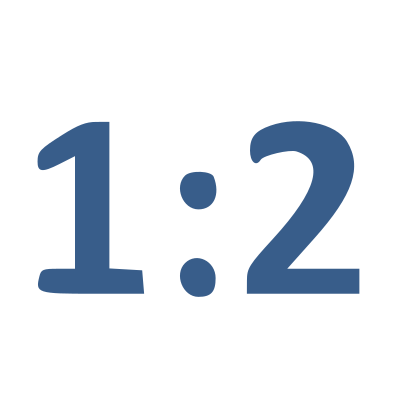 Proportion Proportion
|
|---|
| No Test Result | No Test Result: No test result is available for the test ear.
Record as True if the clinician was unable to record a result for the test ear. |
|---|
| Reason for No Test Result | Reason for No Test Result: Reason why no result is available for the test ear.
Coding with a terminology is preferred, where possible. For example, patient was not co-operative; patient was not capable; ran out of time; no seal; presence of tympanic membrane perforation, impacted wax or discharge. |
|---|
| Tympanogram Type | Tympanogram Type: Description of the the shape of the tympanogram curve, based on the Jerger categories.
If Type B or C subtypes are to be used in an implementation, these should be substituted for the global 'Type B' or 'Type C' classification here.
Both 'Type B' and 'Type B - low compliance'/'Type B - high compliance' should not be used in the same implementation. Similarly, both 'Type C' and Types C1-3 should not be used in the same implementation.
- Type A
- Type B
- Type B with high ECV
- Type C
- Type D
- Type As
- Type Ad
- Indeterminate
|
|---|
| Tympanogram Type B Subtype | Tympanogram Type B Subtype: Subclassification of the tympanograms with a flat curve.
If the subtypes are to be used in an implementation, these should be substituted for the global Type B category in the 'Tympanogram Type' data element. Both 'Type B' and 'Type B - low/high compliance' should not be used in the same implementation. 'Type B - low complicance' is equivalent to the unqualified 'Type B' in the 'Tympanogram Type' data element.
- Type B - high compliance
- Type B - low compliance
|
|---|
| Tympanogram Type C Subtype | Tympanogram Type C Subtype: Subclassification of the tympanograms with negative peak pressure.
If the subtypes are to be used in an implementation, these should be substituted for the global Type C category in the 'Tympanogram Type' data element. Both Type C and Types C1-3 should not be used in the same implementation.
|
|---|
| Screening Outcome | Screening Outcome: Overall result of screening.
In some existing screening programs, the result has previously been recorded as one of three options: 'Pass', 'Re-test' or 'Refer'. This confounds the result with subsequent next actions. This data element is recording the outcome of the test alone - thus 'Pass' or 'Fail' are the only two options. Following a 'Fail' result, a clinical system can support the clinician to initiate appropriate a subsequent activity (eg based on other information such as previous screening test results) - either a rescheduling of the screening test (ie a 'Re-test') or initiation of a referral for further investigation (ie a 'Refer').
|
|---|
| Clinical Interpretation | Clinical Interpretation: Clinical interpretation of all measurements for the test ear.
Coding with a terminology is preferred, where possible.
- Normal middle ear function
- Reduced middle ear compliance (hypomobile)
- Increased middle ear compliance (hypermobile)
- No compliance
- Tympanic membrane perforation
- Eustachian tube dysfunction
- Other
|
|---|
| Overall Interpretation | Overall Interpretation: Overall clinical interpretation of the measurements and related findings using an tympanometer.
Coding with a terminology is preferred, where possible. This data element is effectively an tympanometric diagnosis. |
|---|
| Test Result Image | Test Result Image: Digital representation of the entire result. |
|---|
| Comment | Comment: Additional narrative about the test results and intepretation not captured in other fields. |
|---|
| Baseline | Baseline: Measurement collection recorded as the basis for comparison with following measurement collections that may included other variables of time or patient state. |
|---|
| Data | |
|---|
| Test Details | Test Details: The tympanogram test details, recorded per ear. |
|---|
| Test Ear | Test Ear: Identification of the ear being tested.
|
|---|
| Measurement Details | Measurement Details: Measurements of middle ear function. |
|---|
| Pressure vs Compliance Measurement | Pressure vs Compliance Measurement: The Pressure/Compliance pair as measured by a tympanogram.
Multiple instances of this measurement will form the basis for the graphical display of the tympanogram. |
|---|
| Pressure | Pressure: The pressure measured in the ear canal.
-600..200
Units: |
|---|
| Compliance (Conductance) | Compliance (Conductance): The amount of acoustic energy absorbed by the middle ear system at a specified pressure, measured in mmHo.
0..5 mmho |
|---|
| Compliance (Volume) | Compliance (Volume): The amount of acoustic energy absorbed by the middle ear system at a specified pressure, measured in cc or ml.
Units: |
|---|
| Peak Pressure | Peak Pressure: Peak pressure (also called middle ear pressure or MEP) is the ear canal pressure at which the peak of the tympanogram occurs.
Also known as Middle Ear Pressure (MEP). It is plotted on the horizontal axis on a tympanogram.
-400..200
Units: |
|---|
| Static Compliance | Static Compliance: Static compliance (SC) is the greatest amount of acoustic energy absorbed by the middle ear system (the vertical peak of the tympanogram curve).
Also known as 'Static Admittance'. It is plotted on the verical axis of a tympanogram.
0..5 mmho |
|---|
| Ear Canal Volume | Ear Canal Volume: An estimate of the volume of air between the probe tip and the tympanic membrane if the tympanic membrane is intact, or the volume of the ear canal and the middle ear space if the tympanic membrane is perforated. (Fowler & Shanks, 2002, p. 180).
0..5; 0..5
Units: |
|---|
| Tympanometric Width | Tympanometric Width: The pressure interval corresponding to a 50% reduction in the peak static admittance.
This value is typically derived from the Tympanogram curve. In some immittance machines, for example the Grason Stadler GSI 39, this data element is known as 'gradient'.
0..400 daPa |
|---|
| Tympanometric Gradient | Tympanometric Gradient: The steepness of the slope of the tympanogram near the peak.
This value is typically derived from the Tympanogram curve.
- QuantityUnits: mmho
- Proportion
|
|---|
| No Test Result | No Test Result: No test result is available for the test ear.
Record as True if the clinician was unable to record a result for the test ear. |
|---|
| Reason for No Test Result | Reason for No Test Result: Reason why no result is available for the test ear.
Coding with a terminology is preferred, where possible. For example, patient was not co-operative; patient was not capable; ran out of time; no seal; presence of tympanic membrane perforation, impacted wax or discharge. |
|---|
| Tympanogram Type | Tympanogram Type: Description of the the shape of the tympanogram curve, based on the Jerger categories.
If Type B or C subtypes are to be used in an implementation, these should be substituted for the global 'Type B' or 'Type C' classification here.
Both 'Type B' and 'Type B - low compliance'/'Type B - high compliance' should not be used in the same implementation. Similarly, both 'Type C' and Types C1-3 should not be used in the same implementation.
- Type A
- Type B
- Type B with high ECV
- Type C
- Type D
- Type As
- Type Ad
- Indeterminate
|
|---|
| Tympanogram Type B Subtype | Tympanogram Type B Subtype: Subclassification of the tympanograms with a flat curve.
If the subtypes are to be used in an implementation, these should be substituted for the global Type B category in the 'Tympanogram Type' data element. Both 'Type B' and 'Type B - low/high compliance' should not be used in the same implementation. 'Type B - low complicance' is equivalent to the unqualified 'Type B' in the 'Tympanogram Type' data element.
- Type B - high compliance
- Type B - low compliance
|
|---|
| Tympanogram Type C Subtype | Tympanogram Type C Subtype: Subclassification of the tympanograms with negative peak pressure.
If the subtypes are to be used in an implementation, these should be substituted for the global Type C category in the 'Tympanogram Type' data element. Both Type C and Types C1-3 should not be used in the same implementation.
|
|---|
| Screening Outcome | Screening Outcome: Overall result of screening.
In some existing screening programs, the result has previously been recorded as one of three options: 'Pass', 'Re-test' or 'Refer'. This confounds the result with subsequent next actions. This data element is recording the outcome of the test alone - thus 'Pass' or 'Fail' are the only two options. Following a 'Fail' result, a clinical system can support the clinician to initiate appropriate a subsequent activity (eg based on other information such as previous screening test results) - either a rescheduling of the screening test (ie a 'Re-test') or initiation of a referral for further investigation (ie a 'Refer').
|
|---|
| Clinical Interpretation | Clinical Interpretation: Clinical interpretation of all measurements for the test ear.
Coding with a terminology is preferred, where possible.
- Normal middle ear function
- Reduced middle ear compliance (hypomobile
- Increased middle ear compliance (hypermobile)
- No compliance
- Tympanic membrane perforation
- Eustachian tube dysfunction
- Other
|
|---|
| Overall Interpretation | Overall Interpretation: Overall clinical interpretation of the measurements and related findings using an tympanometer.
Coding with a terminology is preferred, where possible. This data element is effectively an tympanometric diagnosis. |
|---|
| Test Result Image | Test Result Image: Digital representation of the entire result. |
|---|
| Comment | Comment: Additional narrative about the test results and intepretation not captured in other fields. |
|---|
| Post Valsalva | Post Valsalva: Measurements are recorded after the patient has performed a valsalva manoeuvre. |
|---|
| Data | |
|---|
| Test Details | Test Details: The tympanogram test details, recorded per ear. |
|---|
| Test Ear | Test Ear: Identification of the ear being tested.
|
|---|
| Measurement Details | Measurement Details: Measurements of middle ear function. |
|---|
| Pressure vs Compliance Measurement | Pressure vs Compliance Measurement: The Pressure/Compliance pair as measured by a tympanogram.
Multiple instances of this measurement will form the basis for the graphical display of the tympanogram. |
|---|
| Pressure | Pressure: The pressure measured in the ear canal.
-600..200
Units: |
|---|
| Compliance (Conductance) | Compliance (Conductance): The amount of acoustic energy absorbed by the middle ear system at a specified pressure, measured in mmHo.
0..5 mmho |
|---|
| Compliance (Volume) | Compliance (Volume): The amount of acoustic energy absorbed by the middle ear system at a specified pressure, measured in cc or ml.
Units: |
|---|
| Peak Pressure | Peak Pressure: Peak pressure (also called middle ear pressure or MEP) is the ear canal pressure at which the peak of the tympanogram occurs.
Also known as Middle Ear Pressure (MEP). It is plotted on the horizontal axis on a tympanogram.
-400..200
Units: |
|---|
| Static Compliance | Static Compliance: Static compliance (SC) is the greatest amount of acoustic energy absorbed by the middle ear system (the vertical peak of the tympanogram curve).
Also known as 'Static Admittance'. It is plotted on the verical axis of a tympanogram.
0..5 mmho |
|---|
| Ear Canal Volume | Ear Canal Volume: An estimate of the volume of air between the probe tip and the tympanic membrane if the tympanic membrane is intact, or the volume of the ear canal and the middle ear space if the tympanic membrane is perforated. (Fowler & Shanks, 2002, p. 180).
0..5; 0..5
Units: |
|---|
| Tympanometric Width | Tympanometric Width: The pressure interval corresponding to a 50% reduction in the peak static admittance.
This value is typically derived from the Tympanogram curve. In some immittance machines, for example the Grason Stadler GSI 39, this data element is known as 'gradient'.
0..400 daPa |
|---|
| Tympanometric Gradient | Tympanometric Gradient: The steepness of the slope of the tympanogram near the peak.
This value is typically derived from the Tympanogram curve.
- QuantityUnits: mmho
- Proportion
|
|---|
| No Test Result | No Test Result: No test result is available for the test ear.
Record as True if the clinician was unable to record a result for the test ear. |
|---|
| Reason for No Test Result | Reason for No Test Result: Reason why no result is available for the test ear.
Coding with a terminology is preferred, where possible. For example, patient was not co-operative; patient was not capable; ran out of time; no seal; presence of tympanic membrane perforation, impacted wax or discharge. |
|---|
| Tympanogram Type | Tympanogram Type: Description of the the shape of the tympanogram curve, based on the Jerger categories.
If Type B or C subtypes are to be used in an implementation, these should be substituted for the global 'Type B' or 'Type C' classification here.
Both 'Type B' and 'Type B - low compliance'/'Type B - high compliance' should not be used in the same implementation. Similarly, both 'Type C' and Types C1-3 should not be used in the same implementation.
- Type A
- Type B
- Type B with high ECV
- Type C
- Type D
- Type As
- Type Ad
- Indeterminate
|
|---|
| Tympanogram Type B Subtype | Tympanogram Type B Subtype: Subclassification of the tympanograms with a flat curve.
If the subtypes are to be used in an implementation, these should be substituted for the global Type B category in the 'Tympanogram Type' data element. Both 'Type B' and 'Type B - low/high compliance' should not be used in the same implementation. 'Type B - low complicance' is equivalent to the unqualified 'Type B' in the 'Tympanogram Type' data element.
- Type B - high compliance
- Type B - low compliance
|
|---|
| Tympanogram Type C Subtype | Tympanogram Type C Subtype: Subclassification of the tympanograms with negative peak pressure.
If the subtypes are to be used in an implementation, these should be substituted for the global Type C category in the 'Tympanogram Type' data element. Both Type C and Types C1-3 should not be used in the same implementation.
|
|---|
| Screening Outcome | Screening Outcome: Overall result of screening.
In some existing screening programs, the result has previously been recorded as one of three options: 'Pass', 'Re-test' or 'Refer'. This confounds the result with subsequent next actions. This data element is recording the outcome of the test alone - thus 'Pass' or 'Fail' are the only two options. Following a 'Fail' result, a clinical system can support the clinician to initiate appropriate a subsequent activity (eg based on other information such as previous screening test results) - either a rescheduling of the screening test (ie a 'Re-test') or initiation of a referral for further investigation (ie a 'Refer').
|
|---|
| Clinical Interpretation | Clinical Interpretation: Clinical interpretation of all measurements for the test ear.
Coding with a terminology is preferred, where possible.
- Normal middle ear function
- Reduced middle ear compliance (hypomobile
- Increased middle ear compliance (hypermobile)
- No compliance
- Tympanic membrane perforation
- Eustachian tube dysfunction
- Other
|
|---|
| Overall Interpretation | Overall Interpretation: Overall clinical interpretation of the measurements and related findings using an tympanometer.
Coding with a terminology is preferred, where possible. This data element is effectively an tympanometric diagnosis. |
|---|
| Test Result Image | Test Result Image: Digital representation of the entire result. |
|---|
| Comment | Comment: Additional narrative about the test results and intepretation not captured in other fields. |
|---|
| Post Toynbee | Post Toynbee: Measurements are recorded after the patient has performed a toynbee manoeuvre. |
|---|
| Data | |
|---|
| Test Details | Test Details: The tympanogram test details, recorded per ear. |
|---|
| Test Ear | Test Ear: Identification of the ear being tested.
|
|---|
| Measurement Details | Measurement Details: Measurements of middle ear function. |
|---|
| Pressure vs Compliance Measurement | Pressure vs Compliance Measurement: The Pressure/Compliance pair as measured by a tympanogram.
Multiple instances of this measurement will form the basis for the graphical display of the tympanogram. |
|---|
| Pressure | Pressure: The pressure measured in the ear canal.
-600..200
Units: |
|---|
| Compliance (Conductance) | Compliance (Conductance): The amount of acoustic energy absorbed by the middle ear system at a specified pressure, measured in mmHo.
0..5 mmho |
|---|
| Compliance (Volume) | Compliance (Volume): The amount of acoustic energy absorbed by the middle ear system at a specified pressure, measured in cc or ml.
Units: |
|---|
| Peak Pressure | Peak Pressure: Peak pressure (also called middle ear pressure or MEP) is the ear canal pressure at which the peak of the tympanogram occurs.
Also known as Middle Ear Pressure (MEP). It is plotted on the horizontal axis on a tympanogram.
-400..200
Units: |
|---|
| Static Compliance | Static Compliance: Static compliance (SC) is the greatest amount of acoustic energy absorbed by the middle ear system (the vertical peak of the tympanogram curve).
Also known as 'Static Admittance'. It is plotted on the verical axis of a tympanogram.
0..5 mmho |
|---|
| Ear Canal Volume | Ear Canal Volume: An estimate of the volume of air between the probe tip and the tympanic membrane if the tympanic membrane is intact, or the volume of the ear canal and the middle ear space if the tympanic membrane is perforated. (Fowler & Shanks, 2002, p. 180).
0..5; 0..5
Units: |
|---|
| Tympanometric Width | Tympanometric Width: The pressure interval corresponding to a 50% reduction in the peak static admittance.
This value is typically derived from the Tympanogram curve. In some immittance machines, for example the Grason Stadler GSI 39, this data element is known as 'gradient'.
0..400 daPa |
|---|
| Tympanometric Gradient | Tympanometric Gradient: The steepness of the slope of the tympanogram near the peak.
This value is typically derived from the Tympanogram curve.
- QuantityUnits: mmho
- Proportion
|
|---|
| No Test Result | No Test Result: No test result is available for the test ear.
Record as True if the clinician was unable to record a result for the test ear. |
|---|
| Reason for No Test Result | Reason for No Test Result: Reason why no result is available for the test ear.
Coding with a terminology is preferred, where possible. For example, patient was not co-operative; patient was not capable; ran out of time; no seal; presence of tympanic membrane perforation, impacted wax or discharge. |
|---|
| Tympanogram Type | Tympanogram Type: Description of the the shape of the tympanogram curve, based on the Jerger categories.
If Type B or C subtypes are to be used in an implementation, these should be substituted for the global 'Type B' or 'Type C' classification here.
Both 'Type B' and 'Type B - low compliance'/'Type B - high compliance' should not be used in the same implementation. Similarly, both 'Type C' and Types C1-3 should not be used in the same implementation.
- Type A
- Type B
- Type B with high ECV
- Type C
- Type D
- Type As
- Type Ad
- Indeterminate
|
|---|
| Tympanogram Type B Subtype | Tympanogram Type B Subtype: Subclassification of the tympanograms with a flat curve.
If the subtypes are to be used in an implementation, these should be substituted for the global Type B category in the 'Tympanogram Type' data element. Both 'Type B' and 'Type B - low/high compliance' should not be used in the same implementation. 'Type B - low complicance' is equivalent to the unqualified 'Type B' in the 'Tympanogram Type' data element.
- Type B - high compliance
- Type B - low compliance
|
|---|
| Tympanogram Type C Subtype | Tympanogram Type C Subtype: Subclassification of the tympanograms with negative peak pressure.
If the subtypes are to be used in an implementation, these should be substituted for the global Type C category in the 'Tympanogram Type' data element. Both Type C and Types C1-3 should not be used in the same implementation.
|
|---|
| Screening Outcome | Screening Outcome: Overall result of screening.
In some existing screening programs, the result has previously been recorded as one of three options: 'Pass', 'Re-test' or 'Refer'. This confounds the result with subsequent next actions. This data element is recording the outcome of the test alone - thus 'Pass' or 'Fail' are the only two options. Following a 'Fail' result, a clinical system can support the clinician to initiate appropriate a subsequent activity (eg based on other information such as previous screening test results) - either a rescheduling of the screening test (ie a 'Re-test') or initiation of a referral for further investigation (ie a 'Refer').
|
|---|
| Clinical Interpretation | Clinical Interpretation: Clinical interpretation of all measurements for the test ear.
Coding with a terminology is preferred, where possible.
- Normal middle ear function
- Reduced middle ear compliance (hypomobile
- Increased middle ear compliance (hypermobile)
- No compliance
- Tympanic membrane perforation
- Eustachian tube dysfunction
- Other
|
|---|
| Overall Interpretation | Overall Interpretation: Overall clinical interpretation of the measurements and related findings using an tympanometer.
Coding with a terminology is preferred, where possible. This data element is effectively an tympanometric diagnosis. |
|---|
| Test Result Image | Test Result Image: Digital representation of the entire result. |
|---|
| Comment | Comment: Additional narrative about the test results and intepretation not captured in other fields. |
|---|
| Protocol | |
|---|
| Direction of Pressure Change | Direction of Pressure Change: The dirction of change of pressure administered via the ear canal.
|
|---|
| Rate of Pressure Change | Rate of Pressure Change: The rate of change of pressure used in tympanometry.
Units: daPa/s |
|---|
| Admittance Measurement | Admittance Measurement: Method of acoustic admittance measurement used in the test.
- Peak compensated static
- Ambient compensated static
|
|---|
| Pressure Range | Pressure Range: The rate and direction of change in the air pressure in the ear canal used to obtain the tympanogram. |
|---|
| Start Pressure | Start Pressure: The pressure value in daPa at which the pressure sweep for tympanometry begins. It is a positive pressure if the direction of pressure change is descending and a negative pressure if the direction of pressure change is ascending.
Units: |
|---|
| Stop Pressure | Stop Pressure: The pressure value in daPa at which the pressure sweep for tympanometry ends. It is a negative pressure if the direction of pressure change is descending and a positive pressure if the direction of pressure change is ascending.
Units: |
|---|
| Pre-test Calibration Cavity Size | Pre-test Calibration Cavity Size: A cavity with a known volume used to check the calibration of the tympanometer.
ANSI S3.39 requires that three calibration cavities (0.5, 2.0, and 5.0 cm3) be checked with each device.
0.5..5 cc |
|---|
| Screening Pass/Fail Criteria | Screening Pass/Fail Criteria: The criteria by which a screening tympanogram is classified as 'Pass' or 'Fail'. |
|---|
| Criteria for Peak Pressure Pass | Criteria for Peak Pressure Pass: The range of 'Peak Pressure' measurements which fall within the criteria for a 'Pass'.
Lower constraint: Units: daPa
Upper constraint: Units: daPa |
|---|
| Criteria for Static Compliance Pass | Criteria for Static Compliance Pass: The range of 'Static Compliance' measurements which fulfil the criteria for a 'Pass'.
Lower constraint: Units: mmho
Upper constraint: Units: mmho |
|---|
| Criteria for Ear Canal Volume Pass | Criteria for Ear Canal Volume Pass: The range of 'Ear Canal Volume' measurements which fulfil the criteria for a 'Pass'.
Lower constraint: Units:
Upper constraint: Units: |
|---|
| Comment | Comment: Additional narrative about the protocol for the tympanogram not captured in other fields. |
|---|
| Audiogram Result | Audiogram Result: Record of measurements of hearing acuity using a calibrated hearing test device, and their clinical interpretation. |
|---|
| Data | |
|---|
| Any event | Any event: Default, unspecified point in time or interval event which may be explicitly defined in a template or at run-time. |
|---|
| Data | |
|---|
| Test Result Name | Test Result Name: Identification of the Audiometry test performed.
Coding with an external terminology is preferred, where possible. Applicable tests include: Pure Tone Audiometry; Play Audiometry; Auditory Brainstem Response (for threshold determination); and Visual Reinforcement Orientation Audiometry.
- pure tone audiometry
- play audiometry
- VROA
- BOA
- ABR
- other
|
|---|
| Result Details | Result Details: The test result measurements and interpretations which can be recorded per ear, or for both ears simultaneously. |
|---|
| Test Ear | Test Ear: Identification of the ear(s) to which the test stimulus is being presented.
- Left Ear
- Right Ear
- Binaural
|
|---|
| Air Conduction Result | Air Conduction Result: The thresholds obtained using air conduction testing. |
|---|
| Air Conduction Masking | Air Conduction Masking: A masking stimulus was applied to the non-test ear to obtain specified air conduction thresholds. |
|---|
| Measurement | Measurement: The measured frequency/threshold level pair for air conduction results. |
|---|
| Frequency | Frequency: The stimulus frequency tested.
Frequency is not applicable if a click stimulus is presented.
125..16000; 0.125..16
Units: |
|---|
| Threshold Level | Threshold Level: The stimulus intensity at threshold for the test frequency.
-10..120 dB |
|---|
| No Test Result | No Test Result: No air conduction test result is available for the test ear.
Record as True if the clinician was unable to record a result for the test ear or binaural testing in a soundfield, as defined by the 'Test Ear' data element. |
|---|
| Reason for No Result | Reason for No Result: Reason why no air conduction result is available for the test ear.
For example, patient was not cooperative; patient was not capable; ran out of time. |
|---|
| Bone Conduction Result | Bone Conduction Result: The thresholds obtained using bone conduction testing. |
|---|
| Bone Conduction Masking | Bone Conduction Masking: A masking stimulus was applied to the non-test ear to obtain specified bone conduction thresholds. |
|---|
| Measurement | Measurement: The measured frequency/threshold level pair for bone conduction results. |
|---|
| Frequency | Frequency: The stimulus frequency of the test signal.
125..16000; 0.125..16
Units: |
|---|
| Threshold Level | Threshold Level: The intensity of the test stimulus at the subject's threshold for the test frequency.
-10..120 dB |
|---|
| No Test Result | No Test Result: No bone conduction test result is available for the test ear. |
|---|
| Reason for No Result | Reason for No Result: Reason why no bone conduction result is available for the test ear. |
|---|
| Hearing Threshold Interpretation | Hearing Threshold Interpretation: Interpretation of a series of audiometric measurements for purposes of hearing threshold assessment. |
|---|
| Pure Tone Average | Pure Tone Average: The average pure tone threshold according to the specified averaging criteria.
This calculation is typically determined using air conduction thresholds.
-10..120 dB |
|---|
| Degree of Loss | Degree of Loss: Category of the degree of hearing loss derived from the dB threshold values using specified criteria.
Coding with a terminology is desirable, where possible. For example: none, mild, moderate, severe and profound. Each of these categories should be clearly defined on the basis of a dB range appropriate for age.
- none
- mild
- moderate
- severe
- profound
|
|---|
| Type of Loss | Type of Loss: Identified type of hearing loss for the test ear, based on all measurements.
If there is no degree of loss, then this data element is not applicable.
- Conductive
- Sensorineural
- Mixed
- Indeterminate
|
|---|
| Clinical Interpretation | Clinical Interpretation: Clinical interpretation of all measurements for the test ear.
Coding with a terminology is preferred, where possible. Not to be used for recording the interpretation for both ears when the ears are tested simultaneously - use the data element 'Overall Interpretation' instead. |
|---|
| Articulation Index | Articulation Index: An algorithm to predict the amount of speech that is audible to a patient with a specific hearing loss.
|
|---|
| Symmetry of Loss | Symmetry of Loss: An interpretation about the symmetry of hearing loss, based on all hearing acuity measurements for both ears.
|
|---|
| Laterality of Loss | Laterality of Loss: An interpretation about the laterality of hearing loss, based on all hearing acuity measurements for both ears.
If there is no degree of loss in both ears, then this data element is not applicable.
|
|---|
| Overall Interpretation | Overall Interpretation: Overall clinical interpretation of the measurements and related findings using an audiometer.
Coding with a terminology is preferred, where possible. This data element is effectively an audiological diagnosis. Binaural test results reflects either the performance for both ears (if equal hearing) or only the better ear (where there is asymmetric hearing)." |
|---|
| Test Result Image | Test Result Image: Digital representation of the entire result. |
|---|
| Comment | Comment: Additional narrative about the test results and intepretation not captured in other fields. |
|---|
| State | |
|---|
| Aided Status | Aided Status: Indication regarding use of an assistive listening device by the test subject during the test.
Assumed value: Unaided |
|---|
| Pre-test Conditions | Pre-test Conditions: Identification of whether the subject was exposed to a quiet environment for a specified period prior to testing.
- Pre-test quiet
- No pre-test quiet
Assumed value: Pre-test quiet |
|---|
| Protocol | |
|---|
| Presentation | Presentation: Presentation of the test stimulus to the test ear. |
|---|
| Air Conduction | Air Conduction: The indirect transmission of the test stimulus to the inner ear through the atmosphere, via the auditory canal and middle ear structures.
- Soundfield
- Insert earphone
- External headset
|
|---|
| Bone Conduction | Bone Conduction: The direct transmission of the test stimulus to the inner ear via the cranial bones.
|
|---|
| Test Environment | Test Environment: The space and conditions in which the audiometric test is administered.
This data element is commonly used in industry hearing programs.
- Audiometric booth
- Minimal background noise
- Moderate background noise
- High background noise
|
|---|
| Test Stimulus | Test Stimulus: Identification of the stimulus used in the hearing test to measure the hearing threshold.
- Tone Burst
- Click
- Warble Tone
- Pure Tone
- Narrow Band Noise
|
|---|
| Click Stimulus Specification | Click Stimulus Specification: Identification of parameters specifying a click stimulus. |
|---|
| Onset Ramp | Onset Ramp: Time over which the stimulus grows to full amplitude.
Units: millisec |
|---|
| Offset Ramp | Offset Ramp: Time over which the stimulus depletes to zero amplitude.
Units: millisec |
|---|
| Total Duration | Total Duration: Total duration of the click stimulus.
Units: millisec |
|---|
| Threshold Determination Protocol | Threshold Determination Protocol: Protocol used to measure the hearing threshold for pure tone, play and visual reinforcement orientation audiometry only.
Not applicable for ABR testing. |
|---|
| Threshold Definition | Threshold Definition: Definition of the protocol used to define the threshold level used in the test.
- Minimum response level
- 2/3 responses
- 3/6 responses
|
|---|
| Step Size | Step Size: The step size (in decibels) of the change in the stimulus intensity for threshold determination.
|
|---|
| Direction | Direction: The direction of change in the stimulus intensity.
|
|---|
| Reliability | Reliability: Narrative description of the reliability of the test results, as determined by the tester.
If an appropriate value set can be determined, this could be coded. The maximum occurrences of this data element have been set to two to allow for both narrative and a coded value to be selected in a template. |
|---|
| Test Modifications Required | Test Modifications Required: Narrative description of any modfications to the standard methodology required to enable successful completion of the test. |
|---|
| Calibration Reference dB | Calibration Reference dB: Scale used for acoustic calibration of the test signal.
|
|---|
| Criteria for Pure Tone Average | Criteria for Pure Tone Average: The criteria on which the Pure Tone Average is calculated. The average is based on air conduction thresholds and masked thresholds replace unmasked thresholds when applying the formula.
If recording the Criteria as a narrative, it is possible to identify the frequencies used for non-standard Pure Tone Average as free text.
 Coded Text Coded Text- 3 frequency average
- 4 frequency average
 Text Text
|
|---|
| Criteria for Asymmetry | Criteria for Asymmetry: The criteria on which asymmetry is defined in the test result interpretation.
For example: binaural difference in bone conduction thresholds of >10 dB at two consecutive frequencies or >15 dB at one frequency (0.25–8.0 kHz). |
|---|
| Comment | Comment: Additional narrative about the protocol for the audiogram not captured in other fields.
For example, the co-operation of the test subject or description of the method used for testing. |
|---|
| Diagnosis | Diagnosis: A generic heading for contextual renaming within a template. |
|---|
| Problem/Diagnosis | Problem/Diagnosis: Any health care condition which may impact on the physical, mental and/or social well-being of an individual, that may require diagnostic, therapeutic or educational action, and which has been determined by a clinician. A diagnosis is based on scientific evaluation of physical signs, symptoms, history, laboratory tests results, and procedures. |
|---|
| Data | |
|---|
| Problem/Diagnosis | Problem/Diagnosis: Identification of the problem or diagnosis. Coding of the problem or diagnosis with a terminology is preferred, where possible.
- None
- Acute Otitis media without Perforation (AOMwoP)
- Acute Otitis media with perforation (AOMwip)
- Recurrent Acute Otitis Media (rAOM)
- Otitis Media with Effusion (OME)
- Persitent (Chronic) Otitis Media with Effusion (pOME)
- Chronic Suppurative Otitis Media (CSOM)
- Dry Perforation
- Otitis Externa
- Other
- Hearing Loss
|
|---|
| Clinical description | Clinical description: Narrative description or comments about clinical aspects of the problem/diagnosis. |
|---|
| Severity | Severity: A subjective assessment of the severity of the Problem/Diagnosis as evaluated by the clinician. Coding of the severity with a terminology is preferred, where possible.
- High risk of persistent (Chronic) OME (pOME)
- High risk of CSOM
- High risk of lanaguage and learning hearing loss consequences
- High risk of social and emotional hearing loss consequences
|
|---|
| Date of onset | Date of onset: Estimated or actual date the problem/diagnosis began, in the opinion of the clinician. |
|---|
| Age at onset | Age at onset: The estimated or actual age of the individual when the clinician assesses that the problem/diagnosis began.
Note: May be important in situations where approximations of age based on calculations are not accurate enough, eg in infants under one year. |
|---|
| Occurrence summary | Occurrence summary: Summary information about occurrences or exacerbations.
Note: Detailed information about each occurrence or exacerbation is likely to be held in other parts of the health record. |
|---|
| Number | Number: Cumulative number of occurrences or exacerbations of the problem/diagnosis.
>=1 |
|---|
| Frequency | Frequency: The frequency or estimated frequency of occurrences or exacerbations of the problem/diagnosis.
Units: |
|---|
| Latest occurrence | Latest occurrence: The date of the last occurrence or exacerbation of the problem/diagnosis. |
|---|
| Description | Description: A narrative description, including outcomes and other key details, about occurrences or exacerbations of the problem/diagnosis. |
|---|
| Link to occurrence details | Link to occurrence details: Link to further information about past occurrences or exacerbations of the problem/diagnosis that exist elsewhere in the health record. |
|---|
| Related items | Related items: Further problems, diagnoses, procedures or events that are related in some way to this problem/diagnosis. |
|---|
| Related item | Related item: Identification of a related problem, diagnosis, procedure, or event as text, coded text or link within the health record. Note: It is desirable that this field should be coded using terminology, wherever possible. |
|---|
| Relationship type | Relationship type: The type of relationship that this problem/diagnosis has to the related item.
|
|---|
| Date of resolution/remission | Date of resolution/remission: The date or estimated date that the problem/diagnosis resolved or went into remission. |
|---|
| Age at resolution/remission | Age at resolution/remission: The age of the person at the time of resolution or remission of the problem/diagnosis.
Note: May be important in situations where approximations of age based on calculations are not accurate enough, eg in infants under one year. |
|---|
| Comment | Comment: Additional narrative about the problem or diagnosis not captured in other fields. |
|---|
| Protocol | |
|---|
| Link to supporting clinical evidence | Link to supporting clinical evidence: Links to other relevant information, including pathology reports. |
|---|
| Recommendations | Recommendations: A generic heading for contextual renaming within a template. |
|---|
| Plan | Plan: A generic heading for contextual renaming within a template. |
|---|
| Australian Hearing Referral request | Australian Hearing Referral request: Request for provision of a specified service by another healthcare provider or organisation. |
|---|
| Request | Request: Current Activity. |
|---|
| Description | |
|---|
| Service requested | Service requested: Identification of the service requested. This is often coded with an external terminology.
- device consideration
- device follow up
- review
- other
|
|---|
| Reason for request | Reason for request: A short description of the reason for the request. This is often coded with an external terminology.
- bilateral hearing loss
- existing aided client
- existing unaided client
- client request
- school request
- other
|
|---|
| Intent | Intent: Stated intent of the request by the referrer. |
|---|
| Urgency | Urgency: Urgency of the request.
|
|---|
| Date &/or time service required | Date &/or time service required: The date and time that the service should be performed or completed. |
|---|
| Latest date service required | Latest date service required: The latest date that is acceptable for the service to be completed. |
|---|
| Supplementary information to follow | Supplementary information to follow: True indicates that additional information has been identified and will be forwarded when available eg incomplete pathology test results. |
|---|
| Supplementary information expected | Supplementary information expected: Details of the nature of supplementary information that is to follow e.g name of laboratory results. |
|---|
| Protocol | |
|---|
| Requestor Identifier | Requestor Identifier: The local ID assigned to the order by the healthcare provider or organisation requesting the service. This is also referred to as Placer Order Identifier. |
|---|
| Receiver identifier | Receiver identifier: The ID assigned to the order by the healthcare provider or organisation receiving the request for service. This is also referred to as Filler Order Identifier. |
|---|
| Request status | Request status: The status of the request for service as indicated by the requester.
Status is used to denote whether this is the initial request, or a follow-up request to change or provide supplementary information. |
|---|
| Duration | Duration: Length of time the referral is valid. |
|---|
| Duration | Duration: Duration for which the referral is valid. |
|---|
| Indefinite | Indefinite: If true, referral is for an indefinite period of time. |
|---|
| Follow up Audiology Appointment | Follow up Audiology Appointment: Request for a range of different healthcare services, for example, a referral, lab request, equipment request. |
|---|
| Request | Request: Current Activity. |
|---|
| timing | timing: Annotations- Notes.Authors Note: Value Set: "3 months"; or "6 months"; or "12 months" from the time of recording.
- Notes.Needs A Value Set: Yes
|
|---|
| Description | |
|---|
| Service requested | Service requested: Identification of the service requested. This is often coded with an external terminology.
- diagnostic audiometry
- VROA
- BOA
- ABR
- other
|
|---|
| Reason for request | Reason for request: A short description of the reason for the request. This is often coded with an external terminology.
- monitoring
- pre-surgical assessment
- post surgical assessment
- other
|
|---|
| Intent | Intent: Stated intent of the request by the referrer. |
|---|
| Urgency | Urgency: Urgency of the request.
|
|---|
| Latest date service required | Latest date service required: The latest date that is acceptable for the service to be completed. |
|---|
| Supplementary information to follow | Supplementary information to follow: True indicates that additional information has been identified and will be forwarded when available eg incomplete pathology test results. |
|---|
| Supplementary information expected | Supplementary information expected: Details of the nature of supplementary information that is to follow e.g name of laboratory results. |
|---|
| Protocol | |
|---|
| Requestor Identifier | Requestor Identifier: The local ID assigned to the order by the healthcare provider or organisation requesting the service. This is also referred to as Placer Order Identifier. |
|---|
| Receiver identifier | Receiver identifier: The ID assigned to the order by the healthcare provider or organisation receiving the request for service. This is also referred to as Filler Order Identifier. |
|---|
| Request status | Request status: The status of the request for service as indicated by the requester.
Status is used to denote whether this is the initial request, or a follow-up request to change or provide supplementary information.
|
|---|
| ENT Teleotology Review | ENT Teleotology Review: Request for a range of different healthcare services, for example, a referral, lab request, equipment request. |
|---|
| Request | Request: Current Activity. |
|---|
| Description | |
|---|
| Service requested | Service requested: Identification of the service requested. This is often coded with an external terminology.
- ENT Consultation
- ENT Nurse
- Other
|
|---|
| Description of service | Description of service: A detailed narrative description of the service requested. |
|---|
| Reason for request | Reason for request: A short description of the reason for the request. This is often coded with an external terminology. |
|---|
| Reason description | Reason description: A narrative description explaining the reason for request. |
|---|
| Intent | Intent: Stated intent of the request by the referrer. |
|---|
| Urgency | Urgency: Urgency of the request.
|
|---|
| Latest date service required | Latest date service required: The latest date that is acceptable for the service to be completed. |
|---|
| Supplementary information to follow | Supplementary information to follow: True indicates that additional information has been identified and will be forwarded when available eg incomplete pathology test results. |
|---|
| Supplementary information expected | Supplementary information expected: Details of the nature of supplementary information that is to follow e.g name of laboratory results. |
|---|
| Protocol | |
|---|
| Requestor Identifier | Requestor Identifier: The local ID assigned to the order by the healthcare provider or organisation requesting the service. This is also referred to as Placer Order Identifier. |
|---|
| Receiver identifier | Receiver identifier: The ID assigned to the order by the healthcare provider or organisation receiving the request for service. This is also referred to as Filler Order Identifier. |
|---|
| Request status | Request status: The status of the request for service as indicated by the requester.
Status is used to denote whether this is the initial request, or a follow-up request to change or provide supplementary information. |
|---|
| Clinical Synopsis | Clinical Synopsis: A narrative summary about a patient, from the perspective of a healthcare provider. |
|---|
| Data | |
|---|
| Synopsis | Synopsis: An abstract or summary narrative of the assessment, conclusion or evaluation of the clinical findings. |
|---|